


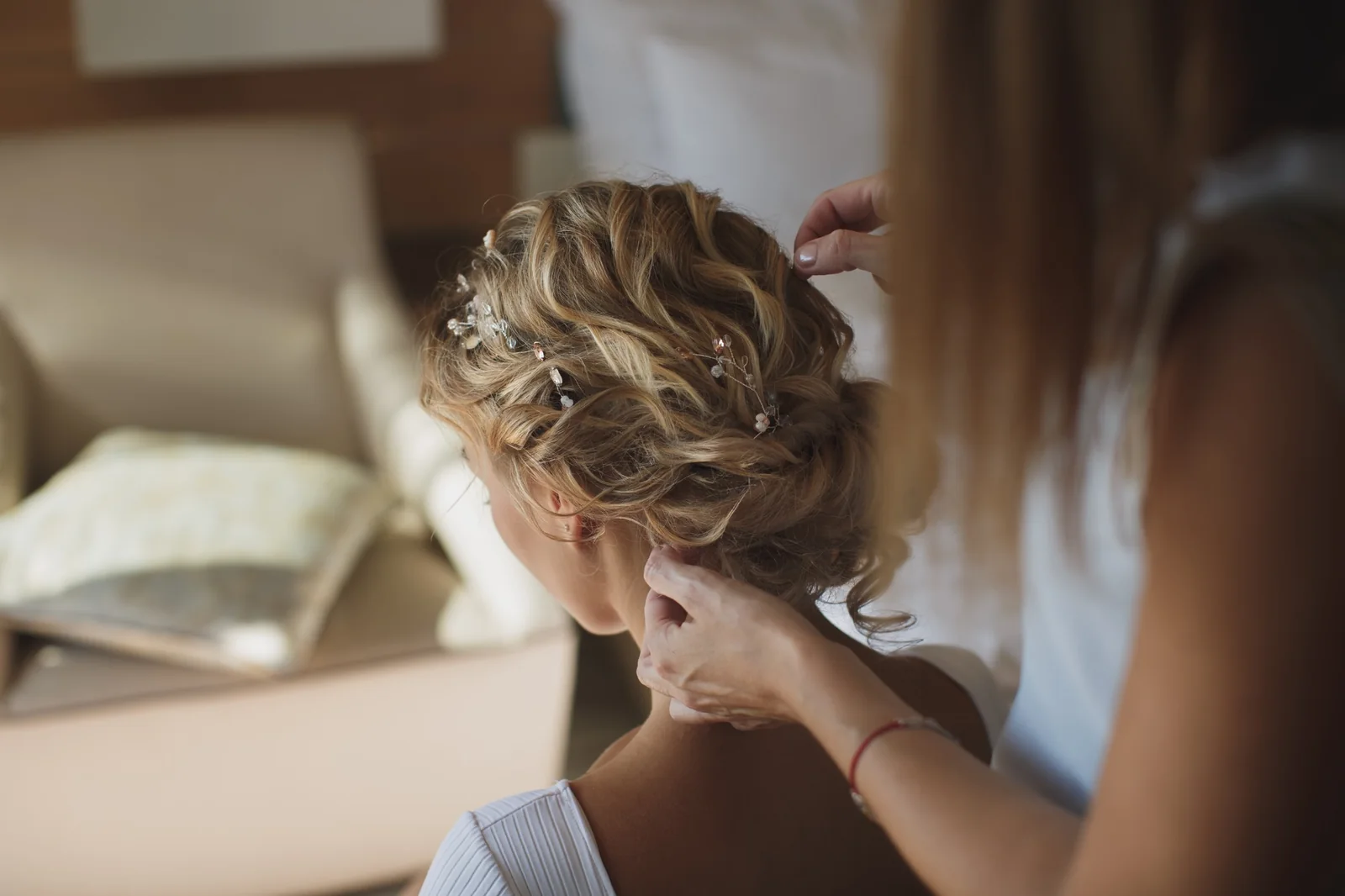
The morning of a wedding has its own atmosphere. People arrive, music starts playing, dresses come out of bags, someone opens a bottle, somebody else is looking for something they were certain they packed the night before.
It is often one of the most relaxed parts of the day — until it suddenly isn't.
Hair and makeup takes slightly longer than expected. A button needs fixing. Flowers arrive. Someone disappears to another room. The car is outside and suddenly everybody is watching the clock.
A little breathing room in the morning makes an enormous difference, both to how the day feels and to what can naturally be captured on film.
Work backwards from when you actually need to leave.
The most useful time on your morning schedule is not the ceremony start time. It is the time you need to walk out of the door.
From there, work backwards.
Allow for the journey to the ceremony, getting into the car, gathering flowers and belongings, a final bathroom visit and the inevitable few minutes when everybody seems to need something at once.
If the ceremony begins at 1.30pm and the venue is twenty minutes away, planning to finish getting dressed at 1.00pm is normally much tighter than it appears on paper.
Being ready earlier does not mean sitting around doing nothing. It means there is room for the final part of the morning to happen without everybody feeling rushed.
The aim isn't to create more time for photographs or film. It's to create more time for the wedding.
Hair and makeup should finish before the last possible moment.
Hair and makeup schedules are usually carefully planned, but this is one of the easiest areas for a wedding morning to begin running behind.
One person takes longer than expected. Someone changes their mind about something. Final touch-ups become more involved.
Wherever possible, I would rather see the bride's main hair and makeup finished with a comfortable buffer before she needs to get dressed.
That creates space for a drink, a conversation, opening a gift, reading a card or simply having five quiet minutes before everything changes pace.
Those unscheduled moments are often much more meaningful on film than another staged shot of the preparations themselves.
Getting dressed almost always takes longer than expected.
A wedding dress rarely goes on in the same way as an ordinary outfit.
There may be buttons, hooks, corsetry, jewellery, shoes, perfume, a veil and final adjustments. People often need to help, and those people also need to be dressed themselves.
It is worth allowing proper time for this rather than treating it as the final ten-minute job before leaving.
From a filmmaking perspective, this is also where the morning often becomes emotionally significant. A mum fastening a dress. A friend helping with jewellery. A parent seeing the finished look for the first time.
None of those moments need to be manufactured when there is enough time for them to happen naturally.
A useful rule
Try to be completely dressed before the point where the schedule says you absolutely have to be.
Keep the important details together.
If you would like details such as invitations, jewellery, perfume, shoes or handwritten notes included in the film, keeping them in one place is a very simple way to make the morning easier.
It means nobody has to search through bags while hair and makeup is happening, and I can film those details without interrupting the people in the room.
This should never become a large styling exercise. A few meaningful objects are normally far more valuable than spending half the morning constructing elaborate flat lays.
The room matters less than the people inside it.
You do not need an enormous bridal suite for beautiful preparation footage.
Natural light helps. A reasonably uncluttered area near a window helps. But the most important thing is still what is happening between the people in the room.
If possible, keeping bags, packaging and overnight belongings to one side gives us a cleaner area to work around without asking everybody to stop what they are doing.
Beyond that, I would much rather preserve a genuine morning than make the room feel like a set.
Leave room for the people who matter.
One of the easiest things to lose when a morning becomes rushed is the time between the obvious events.
The conversation with your dad before you leave. Your bridesmaids seeing you dressed. Someone reading a card. Your mum quietly making one final adjustment.
These moments rarely appear as individual items on a timeline.
They need space around the timeline in order to exist.
What does a relaxed wedding morning actually look like?
There is no single schedule that works for every wedding. The number of people getting ready, the ceremony time, travel, hair and makeup requirements and the venue layout all change the answer.
But the principle stays the same: build in margins rather than scheduling everything to finish exactly when the next thing begins.
If everybody must leave at 12.45pm, I would much rather see the key preparations effectively complete around 12.15pm than watch the final button being fastened at 12.44pm.
Those thirty minutes do not go to waste.
They become the part of the morning where people can actually be present.
Your film benefits when your day benefits.
I do not believe a wedding should be arranged around the filmmaker.
The best footage usually comes from a day that has enough space for people to interact naturally without constantly being moved towards the next thing.
A calmer morning gives me the freedom to observe rather than direct. It means I can capture reactions, conversations and relationships instead of trying to recreate them after the schedule has already fallen behind.
More importantly, it gives you the chance to actually experience the beginning of your wedding day.
Give yourself more time than you think you need.
If there is one thing worth taking from this, it is that an extra twenty or thirty minutes in the morning can be worth far more than trying to optimise every minute of the schedule.
Weddings contain enough things that cannot be predicted.
The timeline should give those things somewhere to happen.
And when the morning feels calm rather than hurried, the film tends to feel the same way.